
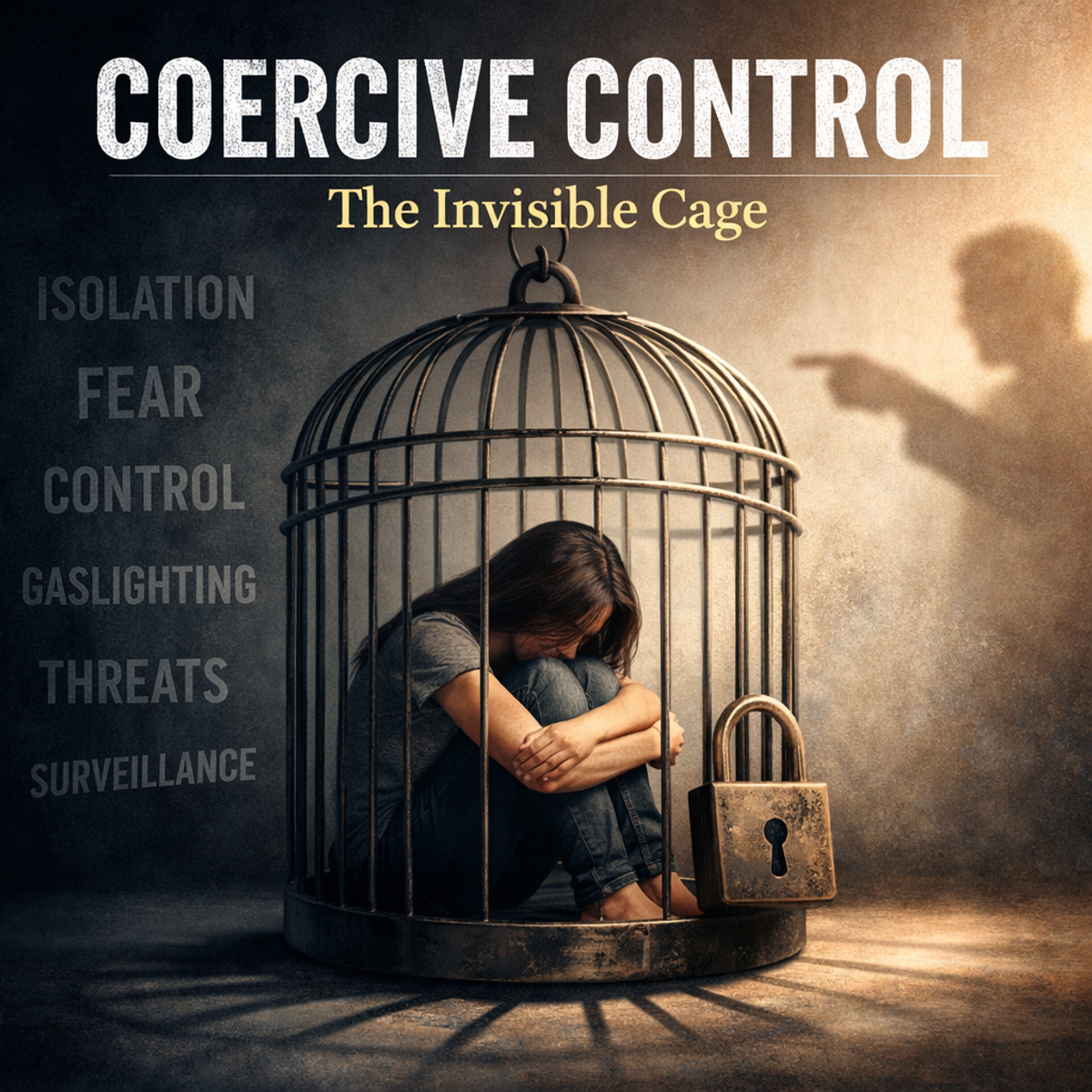
When we talk about abusive relationships, we often picture bruises, shouting, or obvious violence. But some of the most damaging abuse can be almost invisible from the outside. This is coercive control: a pattern of dominating, isolating, and frightening someone until their sense of self, safety, and freedom shrinks to almost nothing.
Coercive control is a sustained pattern of behaviour designed to erode another person’s autonomy. Because it often happens slowly and subtly, many people don’t realise they’re being abused until they feel completely trapped.
In this post, we’ll look at what coercive control is, how it shows up, why it’s so dangerous, and what someone can do if they recognise these patterns in their life.
What Is Coercive Control?
Coercive control is a form of psychological and emotional abuse in which one person uses a range of tactics to dominate another. The goal isn’t just to “win” arguments or get their way occasionally, but to systematically undermine the other person’s independence, confidence, and support systems.
It can occur in any intimate relationship – dating partners, spouses, ex-partners who share children, and sometimes even within close family or caregiving dynamics.
Unlike one-off incidents of conflict, coercive control is about patterns: repeated criticism or humiliation, monitoring and surveillance, restricting access to money or support networks, and using threats, intimidation, or guilt to maintain power.
Even if there is never a slap, a shove, or a visible injury, coercive control is still abuse, and often profoundly damaging.
How Coercive Control Shows Up
Coercive control rarely begins with something obviously extreme. It often starts with behaviour that can be disguised as care, protectiveness, or intense love.
1. Isolation from Friends, Family, and Support
What it can look like:
- “I don’t like your friends; they’re a bad influence.”
- “Your family doesn’t really understand us – let’s just focus on us.”
- Sulking or punishing you emotionally if you spend time with others
Over time, you might find yourself cancelling plans to avoid conflict, sharing less of what’s really happening, and gradually losing touch with people who could help you see the situation clearly.
Isolation increases dependence on the controlling partner and reduces access to outside perspective.
2. Monitoring, Surveillance, and Invasion of Privacy
What it can look like:
- Demanding passwords to your phone, social media, or email
- Insisting on constant check-ins, location sharing, or video calls
- Reading your messages or call history
- Questioning you relentlessly about where you’ve been
This is often framed as concern:
“I just worry about you.”
“If you’ve got nothing to hide, why does it matter?”
In reality, you’re being monitored, and that changes how freely you move through the world.
3. Control Over Finances and Daily Life
Financial and practical control can be just as powerful as emotional manipulation.
This might involve one person insisting all money goes through them, giving “allowances” and demanding receipts, interfering with employment, or controlling access to transport, keys, or identification.
These restrictions make leaving not just emotionally difficult, but logistically overwhelming.
4. Emotional Manipulation and Gaslighting
Gaslighting is when someone causes you to doubt your memory, perception, or sanity.
It may sound like:
- “That never happened – you’re imagining things.”
- “You’re overreacting.”
- “Everyone else thinks you’re the problem too.”
Other tactics can include the silent treatment, sudden emotional withdrawal, intense apologies or “love-bombing” after outbursts and using your vulnerabilities against you.
The cumulative effect is often confusion, self-doubt, and a growing sense that you can’t trust your own judgement.
5. Threats, Intimidation, and Fear
Coercive control often involves threats – sometimes subtle, sometimes explicit – even if they’re not always acted on.
This might include threatening self-harm if you leave, threatening to take children or damage your reputation, or intimidating behaviour such as smashing objects, driving dangerously, or invading your physical space.
The message doesn’t need to be spoken outright: if you step out of line, there will be consequences. That fear alone can be enough to maintain control.
Why Coercive Control Is So Dangerous
It Erodes Your Sense of Self
Over time, many victims find themselves thinking:
- “I don’t know who I am anymore.”
- “I feel like I’m walking on eggshells.”
- “I can’t make decisions without checking first.”
This isn’t just a difficult relationship, it’s a gradual erosion of confidence, boundaries, and identity.
It Can Be a Precursor to Physical Violence
Not every controlling partner becomes physically violent, but many abusive relationships begin with coercive control.
By the time physical abuse appears, the person experiencing it may already be isolated, financially dependent, and emotionally destabilised, making it much harder and more dangerous to leave.
It’s Hard to Recognise and Harder to Prove
From the outside, everything may appear normal: no visible injuries, smiling photos, a partner who seems charming or attentive.
Inside the relationship, however, victims often feel ashamed, confused, or unable to explain what’s happening because it’s made up of countless small, deniable moments.
That invisibility is part of what makes coercive control so powerful.
Common Myths About Coercive Control
“If it was really that bad, they’d just leave.”
Leaving can mean losing housing, income, or children, and may trigger retaliation or escalation. Control is designed to make leaving feel impossible, or dangerous.
“But they never hit me, so it’s not abuse.”
Abuse is not defined only by physical violence. Many survivors say the psychological impact lasts longer.
“They’re just jealous or old-fashioned.”
Jealousy and rigid beliefs are often used to justify control, but they don’t excuse it. Love does not require surveillance, humiliation, or fear.
Early Warning Signs to Watch For
Some red flags that may signal a coercively controlling pattern:
- The relationship moves very quickly, with intense commitment early on
- They criticise or undermine your support network
- They react negatively when you set boundaries
- They expect constant updates on your whereabouts
- You begin hiding harmless things to “keep the peace”
If you consistently feel smaller, more anxious, or less free around someone, that’s a serious warning sign.
If You Recognise Yourself in This
If some of this feels familiar, you’re not alone and it’s not your fault. Some initial steps might include:
Name what’s happening.
Putting language to the behaviour can be painful but clarifying. Writing things down privately can help you see patterns more clearly.
Reach out safely.
Speak to someone you trust outside the relationship, and use a safe device if monitoring is a concern. Specialist helplines can offer confidential support.
Understand your options.
In many places, coercive control is recognised in law. Support organisations can help with safety planning, legal advice, housing, and finances.
Create a safety plan.
Think about who you could contact in an emergency, what essentials you might need, and where you could go if necessary.
Be gentle with yourself.
Coercive control exploits care, loyalty, and hope. Staying does not mean weakness. Leaving, and rebuilding, takes time.
A Final Word
Coercive control is dangerous precisely because it hides in the everyday: in the joke that stings, the “rule” that limits, the apology that never quite leads to change. It thrives in silence, confusion, and self-doubt.
Bringing it into the light – naming it, talking about it, and believing those who share their experiences – is one of the most powerful things we can do.
If anything here resonates with you or someone you care about, let this be a clear reminder:
Love should not feel like fear. Respect never requires control. You deserve safety, autonomy, and a life that feels like your own.
Support
If you need support:
- National Domestic Abuse Helpline – 0808 2000 247 (run by Refuge)
- The Men’s Advice Line, for male domestic abuse survivors – 0808 801 0327 (run by Respect)
- The Mix, free information and support for under 25s in the UK – 0808 808 4994
- National LGBT+ Domestic Abuse Helpline – 0800 999 5428 (run by Galop)
- Samaritans (24/7 service) – 116 123
If you or someone else is in immediate danger, call 999.